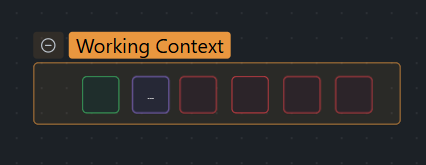
The Working Context is the active memory that the base LLM consumes at inference time. Unlike the unbounded MegaContext Tree, the working context maintains a fixed token budget (W_max) by dynamically mixing raw tokens and compressed gists based on relevance.
What is the Working Context?
The Working Context is the fixed-size attention window that sits in GPU memory and gets fed directly into the frozen base model for inference. While the MegaContext Tree can grow unboundedly on disk (or RAM in the POC), the working context must fit within a strict token budget.
Think of it as the “spotlight” that illuminates different parts of your memory at different resolutions:
- High resolution (LOD0): Raw tokens for the most relevant parts
- Medium resolution (LOD1): 32:1 gists for moderately relevant regions
- Low resolution (LOD2): 1024:1 gists for distant or less important context
This spotlight is continuously refocused by LensNet and Focus Allocator as new information arrives and priorities shift.
Core Properties
Fixed Budget
The working context operates under a strict token budget called W_max. In the POC, this is 8,192 tokens (configurable to 16k–32k). The system maintains the invariant that the sum of all entry costs never exceeds this budget.
For detailed budget mechanics, see Budget Invariant.
Mixed Levels of Detail
The working context contains entries at different LODs based on relevance:
| Entry Type | Token Cost | Coverage |
|---|---|---|
| LOD0 block | 32 tokens | 32 raw tokens |
| LOD1 gist | 1 token | 32 tokens (32:1 compression) |
| LOD2 gist | 1 token | 1,024 tokens (1024:1 compression) |
Contiguous Tiling
Entries tile the MegaContext Tree timeline without gaps or overlaps, maintaining perfect temporal continuity:
Timeline: [0 ─────────────────────────────────────────────────── T]
Working Context: [LOD0: 0-32] [LOD1: 32-64] [LOD1: 64-96] [LOD0: 96-128] ...
This contiguity ensures:
- Coherent narrative flow for the base model
- Consistent RoPE [1] positional encodings
- No discontinuities during focus changes
Relationship to MegaContext Tree
The working context is not a separate data structure—it’s a dynamic view into the MegaContext Tree:
| Aspect | MegaContext Tree | Working Context |
|---|---|---|
| Storage | Persistent (disk/RAM) | Ephemeral (GPU) |
| Scope | Complete history | Recent window |
| Size | Unbounded | Fixed (W_max) |
| Content | All LODs stored | Selective LODs |
| Mutability | Append-only | Dynamic refocus |
| Role | Long-term memory | Active attention |
Analogy: The MegaContext Tree is your brain’s long-term memory (everything you’ve ever learned). The working context is your conscious attention right now (the small subset you’re actively thinking about).
Assembly Process
The working context is assembled from the MegaContext Tree by:
- Selecting a temporal span to cover
- Choosing appropriate LOD for each region based on relevance (using sparse attention patterns [2])
- Fetching data from the tree’s storage
- Materializing embeddings (tokens → embeddings, or gist vectors)
- Concatenating into a single contiguous tensor
For full assembly details, see Working Context Assembly.
Refocusing
The working context evolves continuously as the conversation progresses:
- Cadence: Refocus every K tokens (K=32 in POC)
- Process: LensNet scores entries, Focus Allocator applies expand/collapse operations
- Budget: Expansions and collapses are balanced to maintain the W_max constraint
Why refocus? Dynamic relevance means what was important 1000 tokens ago may no longer matter. Refocusing allows the system to zoom in on newly relevant regions and zoom out on now-irrelevant ones.
For full refocusing mechanics, see Working Context Refocusing.
Base LLM Interaction
From the base model’s perspective, the working context is just another context window. It doesn’t know some embeddings are gists rather than raw tokens:
- Dimensionality match: Gists live in the same embedding space as tokens
- RoPE compatibility: Gists positioned at central token index for consistent encoding [1]
- Substitutability: GistNet trained so gists produce similar hidden states to original tokens
# Standard forward pass
outputs = base_model(
    inputs_embeds=working_context,  # [N, d] - mixed tokens & gists
    attention_mask=attention_mask,
    position_ids=position_ids        # Absolute indices for RoPE [1]
)
System Invariants
The working context maintains several critical invariants:
- Budget Invariant: Total token cost ≤ W_max
- Contiguity Invariant: No gaps or overlaps in temporal coverage
- Block Alignment Invariant: All boundaries align with K-token blocks
- Level Consistency Invariant: Entry LOD matches span size
- RoPE Invariant: Consistent positional encoding
For detailed invariant definitions, see Invariants.
Role in the System
The Working Context is the central coordination point for all components:
- For the base model: The only context it ever sees—a seemingly normal attention window
- For LensNet: Input to analyze and score for focus adjustments
- For Focus Allocator: The budget-constrained space where it applies expand/collapse decisions
- For GistNet: Provides examples of which gists are actually used (for on-policy training)
- For Runtime Loop: The working state that persists across decode steps
POC Implementation
In the proof-of-concept:
- Size: W_max = 8,192 tokens
- Update frequency: Refocus every K=32 tokens
- Initial assembly: Start with most recent tokens/gists from the tree
- No streaming: Entire working context in GPU memory
- Simple heuristics: Initial focus policy with recency bias
See POC Implementation for full details and constraints.
Related Pages
- Working Context Assembly - Detailed assembly process and algorithms
- Working Context Refocusing - Refocusing mechanics and LensNet/Focus Allocator interaction
- Invariants - System-wide constraints including budget, contiguity, and alignment
- MegaContext Tree - The persistent memory structure backing the working context
- LensNet - Neural network that scores entries for relevance
- Focus Allocator - Component that applies expand/collapse operations
- GistNet - Neural network that produces compressed gist embeddings
- POC Implementation - Proof-of-concept constraints and implementation details
References
- RoPE (Su et al., 2021) — Analysis — Rotary position embeddings used throughout MegaContext
- Sparse Transformers (Child et al., 2019) — Analysis — Factorized sparse attention patterns
See Related Work for the complete bibliography of all research papers referenced throughout the documentation.